
Field Note 04 / Petroliana / Documentation
The Anatomy of a Restored Petrol Pump
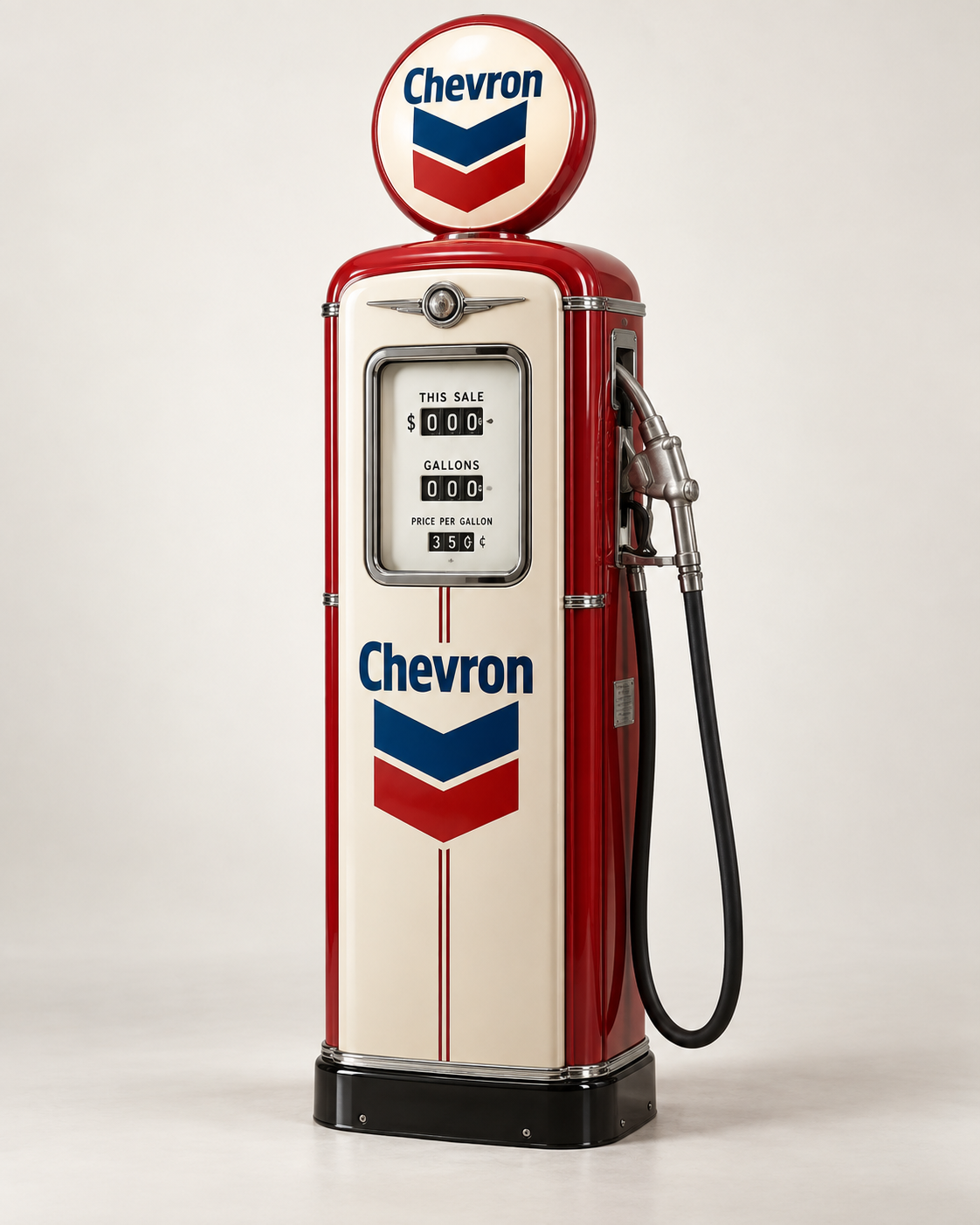
The finished object
A restored petrol pump brings industrial design into the room at architectural scale. Its tall cabinet, rounded shoulders, meter face and elevated sign were conceived to be seen and understood at a glance. In the finished object, colour and proportion remain as important as the machinery that first gave them purpose.
The owner describes the Society’s restoration approach here as retaining original parts and returning the object to its original lustre. That is the restoration account supplied for this presentation. The image shows the finished appearance; it is not offered as a component-by-component technical inspection.
Original parts, recovered presence
Restored and original describe different aspects of the same object. An original component can have been cleaned, refinished or otherwise treated. A catalogue should make room for both its surviving identity and the work that recovered its appearance. Calling the whole object untouched would obscure that history; calling it merely decorative would miss the importance of the retained material.
The standard is to describe the completed work precisely. Here the account is restoration with original parts to original lustre. The maker, exact manufacturing date and earlier station history require their own identification; they do not follow automatically from the Chevron branding.
Read the finished composition
In the presentation above, the round top sign establishes the highest point, the meter occupies the centre, and the contrasting cabinet panels carry the composition down to the base. The hose and nozzle sit to one side, preserving the visual relationship between dispensing apparatus and display face. Red, cream and dark blue give each element a clear place.
This is why petroliana can hold its own beside furniture, lighting or a sculpture. It has volume, a front and profile, a deliberate graphic language, and a scale that changes the space around it. The finished view makes those qualities legible without requiring the restoration process to become the centre of the presentation.
A machine becomes a roadside landmark
The Smithsonian’s account of early gasoline retailing traces the development of equipment and dedicated places to serve motorists. Its early Tokheim pump record shows a movable form from that developing infrastructure. Those histories explain the practical setting from which later, highly visible dispensing designs emerged.
They provide context rather than identification of this particular pump. A maker’s history, an oil company’s identity and an individual object’s restoration are related subjects, but they are not interchangeable. Each deserves its own evidence and description.
Different histories, one collecting standard
A collection built across generations may include restored examples, lightly restored pieces and new old stock. They should not all be given the same condition language. New old stock describes an unused stock history; it does not promise the absence of storage marks, age-related change or later attention. Light restoration should identify the work when its scope is known.
The Society’s intention is to present the finished object beautifully and state its condition honestly. A retained original part, recovered lustre, a storage mark or a later fitting each tells a different part of the story. The description should let the collector appreciate what survives and understand what has been done.
Sources & scope
Object observations refer to the Society’s photographs and owner-supplied catalogue information. External references are identified below; they do not independently authenticate an object in this collection.
- Smithsonian · Gasoline Pump, 1910
Historical context: a Tokheim example, not identification of the illustrated pump.
- Smithsonian · Fill ’er Up!
Context for the development of American gasoline retailing.
Research questions or corrections: hello@theraregoodsociety.com